What Time Dioes the Art Musem Open in Forest Park
| Forest Park | |
|---|---|
 The World'southward Fair Pavilion in Woods Park | |
 Map of Forest Park | |
 | |
| Blazon | Urban park |
| Location | St. Louis,Missouri |
| Coordinates | 38°38′twenty″N 90°17′05″W / 38.6389°N xc.2846°W / 38.6389; -ninety.2846 Coordinates: 38°38′20″N ninety°17′05″W / 38.6389°Northward 90.2846°Westward / 38.6389; -xc.2846 |
| Area | one,326 acres (5,370,000 m2)[1] |
| Created | June 24, 1876 |
| Operated past | St. Louis Parks Department |
| Visitors | thirteen million annually[2] |
| Status | Open all yr (6 a.m. to 10 p.m.) |
| Website | stlouis-mo.gov |
Forest Park is a public park in western St. Louis, Missouri. Information technology is a prominent civic center and covers 1,326 acres (5.37 kmii).[ane] Opened in 1876, more than a decade afterward its proposal, the park has hosted several meaning events, including the Louisiana Purchase Exposition of 1904 and the 1904 Summer Olympics. Bounded past Washington University in St. Louis, Skinker Boulevard, Lindell Boulevard, Kingshighway Boulevard, and Oakland Avenue, it is known as the "Heart of St. Louis" and features a variety of attractions, including the St. Louis Zoo, the St. Louis Art Museum, the Missouri History Museum, and the St. Louis Science Center.[three]
Since the early 2000s, it has carried out a $100 million restoration through a public-private partnership aided by its Master Programme. Changes accept extended to improving landscaping and habitat too. The park'south acreage includes meadows and trees and a multifariousness of ponds, manmade lakes, and freshwater streams. For several years, the park has been restoring prairie and wetlands areas of the park. Information technology has reduced flooding and attracted a much greater multifariousness of birds and wild fauna, which have settled in the new natural habitats.
History [edit]
Early proposals [edit]
An 1864 plan for a big park in the city limits was rejected by St. Louis voters. In 1872, St. Louis developer Hiram Leffingwell proposed a 1,000-acre (4.0 kmtwo) park near three miles (5 km) outside the city limits near land which he owned.[four] Subsequently a period of intense lobbying past Leffingwell, the Missouri Full general Assembly authorized the city to buy the land; nevertheless, city taxpayers challenged the purchase in court, and in 1873, the Missouri Supreme Court overturned the potency.[4] The next year another programmer, Andrew McKinley, prepared another proposal that met legal challenges.[4] The tract selected that became Woods Park included a heavily forested 1,326-acre (5.37 kmtwo) surface area west of Kingshighway forth Olive Street (at present Lindell Boulevard).[4]
Creation of the park [edit]
Using McKinley'south proposal every bit a guide, in 1874 the Full general Assembly passed the Forest Park Act, which established the park and created a canton-wide belongings taxation to fund information technology.[5] In November 1874, the Missouri Supreme Courtroom upheld the new law and referred all questions of land ownership and value to the circuit courtroom.[6] The largest parcels of land needed for the park belonged to Thomas Skinker, Charles P. Chouteau, Julia Maffitt, and William Forsyth, who in 1874 and 1875 sold their land to the city.[4] The urban center purchased the state for $849,058, with another 1000000 dollars dedicated to maintenance and improvement.[7]
The country of the parkland in 1876 was rural: on the eastern and western edges of the park were unpaved roads (Kingshighway and Skinker Route, respectively). Flowing through the northern lowlands and turning southeast in the park was the River des Peres, which at times was very depression while in some seasons could alluvion large areas. The southwestern part of the park was heavily forested land, and the east-due west Clayton Road ran through the southern part of the park. A railroad right-of-style cut through the northeast corner of the park.
Maximillian Yard. Kern and Julius Pitzman, the Prussian-built-in St. Louis Surveyor, designed the Park'southward original plan. The park was dedicated June 24, 1876 with a crowd of about l,000 in attendance. Officials and a band occupied a music stand and podium, and dedicated a statue of Edward Bates, the Attorney General under President Abraham Lincoln.[four] [viii] By the early 1890s, streetcar lines reached the park, carrying nigh three 1000000 visitors a yr. A zoological gardens had been established around 1876 in Fairgrounds Park, on the north side of the urban center;[ix] its animals were eventually transferred to the new Forest Park facility.
Louisiana Buy Exposition [edit]
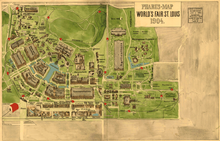
Map of the 1904 Earth'southward Fair, held in Forest Park
In 1901, Forest Park was selected as the location of the 1904 World's Fair, known as the Louisiana Buy Exposition.[10] The fair opened April 30, 1904 and closed December 1, 1904, and information technology left the park vastly different.[11] In add-on to the fair, the park hosted the diving, pond, and water polo events for the 1904 Summer Olympics.[12] Fifteen sports offered Olympic competition events, but women could compete merely in archery. The 1904 Games were the commencement time that African Americans were allowed to compete.[13]
George Kessler, the fair's landscape architect, dramatically inverse the park: the wetlands areas in the western part of the park were drained and converted into h2o features and five connected lakes. Sewer and water lines installed during the fair remained for public use in the park. After the fair, thousands of copse were planted and vistas were created.[11] In 1909, the off-white's directors gave the balance of the remaining profits from the fair toward the construction of a monument to Thomas Jefferson, on the old site of the Fair'south entry gates; when completed in 1913 it became the Missouri History Museum building.[xi] Other structures left from the fair include the St. Louis Fine art Museum, the Apotheosis of St. Louis (a statue of French King Louis IX), the 1904 Bird Cage,[11] (now a function of the St. Louis Zoo), and the Grand Bowl, located at the foot of Fine art Hill, which was the location of the Festival Hall and cascades at the Fair. Though often mistakenly counted among relics of the Off-white, the World's Off-white Pavilion in Forest Park is a later structure, synthetic in 1909 with proceeds from the Louisiana Buy Exposition.
The Palace of the Arts, a building now known as The Saint Louis Art Museum in Forest Park, was divided into six classifications: painting, etchings and engravings, sculpture, architecture, loan drove, and industrial art.[14] In addition to art displays, many novelties were showcased for the first time at the Fair. Electricity, still considered young at the time, was showcased in a number of ways. Attendees at the Fair were awestruck by the electric lighting, both inside and out, of all of the important buildings and roads. The electrical plug and the wall outlet were also displayed. Two of the more notable technological achievements demonstrated were the x-ray machine and the babe incubator.[15]
River des Peres [edit]
At one time the River des Peres ran openly through the park, but due to sanitary concerns, a portion was put hush-hush in a wooden box shortly before the 1904 World'due south Fair.[sixteen] In the 1930s, the portion of the River des Peres that runs through Wood Park was diverted entirely hole-and-corner in huge concrete pipes. More than recently, an artificial waterscape linking park lakes has been created.[17] The river remains underground in the park.
Since the 2000s, the park has restored numerous areas of prairie and wetlands in the park; these new habitats are serving not just to reduce flooding, but to attract a profoundly increased variety of birds and wild animals. They provide a richer experience for walkers and bikers in the park, and the restored areas are full of birdsong.
Hospital lease controversy [edit]
In 1973, Barnes-Jewish Hospital, located beyond Kingshighway from the eastern edge of the park, leased an area of land in Forest Park located to its south for construction of an underground parking garage.[eighteen] Afterwards structure was complete, the surface was restored and a playground was installed; in 1983, the charter was extended to 2050 and the garage was expanded to more than than one,900 spaces.[xviii] [19] Starting in 2006, the infirmary engaged the city to renegotiate the lease to permit for the construction of a building on the site, known as Hudlin Park (although part of Wood Park).[xix] The hospital proposal also included an extension of the lease by 46 years to 2096, providing the hospital 90 years of tenancy.[19] Under the proposal, the almanac rent would increase from $150,000 to between $i.half dozen and $ii.ii one thousand thousand.[xix] The hospital sought to charter more 12 acres (49,000 m2) for which it would pay $ii.two million, or as an culling it would charter the electric current 9.3 acres (38,000 mii) for which it would pay $1.6 million a yr.[19]
Under a January 2007 revised proposal from the hospital, the city would receive $two million for the lease of 9.3 acres (38,000 one thousand2), while the infirmary would agree to make improvements to two areas in Wood Park.[twenty] In February 2007, to proceeds the support of city Comptroller Darlene Green (one of three members of the St. Louis Board of Apportionment and Estimate, a lath that recommends charter proposals to the full Lath of Aldermen), the infirmary agreed to build, fund, and staff a trauma center in North St. Louis.[21] In the February 2007 revised proposal the infirmary as well agreed to retain 15 percent of the country as green space.[21]
Despite considerable protests, the proposal advanced to the St. Louis Board of Aldermen.[20] An activist grouping called Citizens to Protect Forest Park gathered 28,000 signatures to place a ballot measure out that would crave citywide voter approval of all leases or sales of park land.[xx] But, the ballot measure was enacted in April 2007, two months later on the revised lease was approved by the Board of Aldermen.[18]
Utilise [edit]

Forest Park has more than 12 million visitors per yr, surpassing the number of annual visitors to both Busch Stadium and the Gateway Arch National Park combined.[22] [23] In 2022, Wood Park was named the nation'due south best urban center park in the annual U.s. Today Readers' Choice Awards.[24] The park has a diverse patronage, including tourists and local visitors, visitors to park institutions, and special event patrons, with roughly 1 3rd of patrons living inside ten miles (xvi km) of the park, another third between 10 and 30 miles (48 km), and another 3rd living across xxx miles (48 km) from the park.[22] 88 percent of park visitors drive to the park, while the remaining 12 percent are divide between public transit and walking or bicycling to the park.[22] The park has eleven multi-modal access points, listed below by the edge of the park:[22]
- East: Clayton Avenue (outbound), Barnes Hospital Drive, West Pine Boulevard
- West: Forsyth Avenue, Wells Bulldoze (entering)
- North: Due west Pine Boulevard, Union Drive, Cricket Bulldoze, Debaliviere Place
- Due south: Tamm Avenue, Hampton Avenue
The Hampton Avenue entrance is used past about 60 per centum of users inbound the park; this has led to traffic congestion problems that have become more problematic in recent years.[22] [25] To remedy the problem, traffic has been redirected abroad from the Hampton park entrance and trolley-replica buses accept been used to shuttle patrons.[26]
Woods Park hosts several annual St. Louis cultural or entertainment events, including the Great Forest Park Balloon Race (a hot air balloon competition), LouFest Music Festival (August 27–28, 2011), the Shakespeare Festival of St. Louis, the St. Louis Earth Twenty-four hour period Festival, and the St. Louis African Arts Festival.[27] [28] The almanac St. Louis Vino Festival, Beer Heritage Festival, and St. Louis Micro-Fest (a microbrewery showcase festival) as well are hosted in Forest Park.[28] In winter months, the Jewel Box greenhouse hosts a poinsettia show with holiday decorations.[28] Forest Park also hosts able-bodied events, such every bit the St. Louis Pace Series (an annual runway event), the Midnight Ramble (a night bicycling issue), the Forest Park Cross Country Festival,[29] and a variety of run-walk fundraisers.[28] The park has also hosted the The states Cross Land Championships.
On Fine art Hill in early September, the St. Louis Symphony Orchestra offers a costless outdoor concert.[28] The St. Louis Fine art Museum sponsors free outdoor pic showings in the summer on the hill.[30]
Fair St. Louis was held for the first time hither in 2014, due to renovations at the Gateway Curvation grounds, which presents new opportunities for the fair.[31] The fair got off to a smooth start on July 3.[32]
Features [edit]
Woods Park is home to five of the region's major institutions: the St. Louis Fine art Museum, the St. Louis Zoo, the St. Louis Science Center, the Missouri History Museum, and the Muny amphitheater.[33] It has several recreational facilities, including the Dwight Davis Tennis Heart, the Steinberg Skating Rink, the Boathouse Restaurant (with boat rentals), the Woods Park Golf Course, the Highlands Golf and Tennis Center, handball courts, and fields for softball, baseball, soccer, cricket, rugby, and archery. The park too features over thirty miles of walking and bicycling paths.[2]
Saint Louis Zoo [edit]

The most visited feature of the park is the Saint Louis Zoo, a gratis zoo that opened in 1910.[34] In 2010, the zoo attracted ii.nine million visitors to its drove of more eighteen,000 animals.[35] [36] The zoo is divided into v animal zones: the River's Edge, which includes elephants, cheetahs, and hyenas; The Wild, which includes penguins, bears, and slap-up apes; Discovery Zone, which includes a petting zoo; Red Rocks, which features lions, tigers, and other large cats; and the oldest part of the zoo, Historic Hill, which features the 1904 Flight Cage, a herpetarium, and primate house.[37] A sixth zoo zone, known as Lakeside Crossing, features several dining and retail options.[37] For brute care, the zoo also features a veterinary hospital and beast nutrition center.[36]
Saint Louis Science Center [edit]
The Saint Louis Science Center, across Interstate 64 on the southern edge of Forest Park, received slightly more than a million visitors in 2010.[35] Part of the science heart, the McDonnell Planetarium, is located within the park and is connected to the primary building past an enclosed footbridge.[38] In addition to the Orthwein StarBay planetarium show featuring more than 9,000 stars on an 80-pes (24 one thousand) ceiling, the facility offers exhibits nigh living in space. It also hosts monthly public stargazing events co-sponsored by the St. Louis Astronomical Social club.[39] [40]
Missouri History Museum [edit]

The Missouri History Museum opened in Forest Park in 1913.
The Missouri History Museum, located on the northern border of the park, received slightly more than than 500,000 visitors in 2010 to both its permanent and temporary exhibits.[35] The museum has 2 continuing exhibits: Seeking St. Louis, ii galleries focusing on the history of Greater St. Louis;[41] and the 1904 World'due south Off-white, Looking Dorsum at Looking Forward, an showroom of artifacts from the Louisiana Buy Exposition.[42] The museum had a 16-ton statue of Thomas Jefferson sculpted by Karl Bitter, which was unveiled at the opening of the museum in 1913.[43] [44] The museum completed a major expansion in 2000, with the addition of the Emerson Center, a 92,000-square-foot (8,500 one thousand2) building with 24,000 square anxiety (ii,200 grand2) of exhibition infinite, the Lee Auditorium, a 350-seat theater, and space for retail and dining options.[44]
Saint Louis Art Museum [edit]
The Saint Louis Art Museum, which opened every bit the Palace of Fine Arts as part of the Louisiana Purchase Exposition, is located in the merely permanent construction built for the fair.[45] The edifice, designed by Cass Gilbert, houses a comprehensive art museum with particular depth in Oceanic art, Pre-Columbian fine art, ancient Chinese bronzes, and 20th-century High german art.[45] [46]
The museum began an expansion and renovation project in January 2010 under the direction of architect David Chipperfield.[47] The construction relocated surface parking underneath the addition and created a new lower-level gallery, with a full of more than 200,000 foursquare feet (xix,000 chiliad2) of new building area which allows display of more of the drove.[47] The project includes new landscaping, with groves of white birch trees. A site-specific sculpture was deputed from Andy Goldsworthy, who completed installation of Stone Body of water in the fall of 2012.
The Muny [edit]
The Muny, officially known as the Municipal Theatre Association of St. Louis, has operated in Forest Park since 1916.[48] The outset production, As You Like It by William Shakespeare, predated the current edifice by one year; as part of an advertising convention, St. Louis synthetic the Municipal Theatre in 1917.[48] Starting in 1919, the Muny was incorporated, and more than ane,500 seats in the 11,000-seat amphitheater were reserved as permanently free.[48]
The Jewel Box [edit]
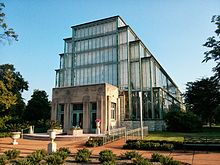
The Jewel Box, a greenhouse and issue venue
The Jewel Box, an fine art deco greenhouse, operates as an effect venue and horticultural facility.[49] The building has nearly seven,500 square anxiety (700 m2) of brandish space and is 55 anxiety (17 m) high, and information technology was congenital in 1936 using funds from the Works Progress Administration.[49] The Jewel Box was added to the National Register of Celebrated Places in 2000.
In 2002, the Gem Box received a $3.5 one thousand thousand renovation, which included the removal and reinstallation of interior plantings, upgrades to the heating and ac systems, and modifications to allow the building to be used for catered events.[49] [50]
Turtle Park [edit]
Turtle Park is a sculpture park created by Bob Cassilly located at Oakland Avenue and Tamm Artery. The park contains concrete sculptures of seven turtle species that are endemic to Missouri,[51] a clutch of eggs and a ophidian. The iii large turtles are a snapping turtle, a Mississippi map turtle and a blood-red-eared slider and the four smaller turtles are a stinkpot turtle and three box turtles.[52] The snapping turtle is 40-foot long and used 120,000 pounds of concrete.[51] The design allows kids to climb on the turtle's shells and in their open up mouths.[52]
Dwight Davis Tennis Heart [edit]
The Dwight Davis Tennis Center is a tennis facility with nineteen lighted tennis courts and a clubhouse, named later St. Louis tennis player Dwight Davis.[53] The facility offers tennis training programs, and sponsors tournaments. It hosts the St. Louis Aces, a local lawn tennis singles team, who play in the i,100-seat Stadium Courtroom.[53] In 2006 and 2007, several courts were refinished, while new shade awnings and benches were provided for players and spectators.[53]
Boathouse [edit]
The Boathouse at Forest Park is both a restaurant and boat rental facility.[54] Since the opening of Forest Park in 1876, boating has been an activeness in the park; in 1894, the St. Louis Postal service-Acceleration paid more than than 6,000 workers to expand one of the lakes in the park.[55] In the early 2000s, a new boathouse opened with access to both Post-Acceleration Lake and the Grand Basin at the foot of Fine art Loma.[54] The boathouse, open yr-round, offers paddle boat rentals. Information technology was designed by St. Louis architect Laurent Torno in the style of early 20th-century Midwestern boathouse cottages.[55]
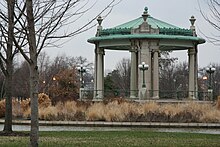
The bandstand in Pagoda Circle
Pagoda Circle [edit]
Pagoda Circle, located in front of the Muny, is a circular drive located around a lake with an island.[56] On the island is the Nathan Frank Bandstand, which was built using funds donated by local businessman Nathan Frank in 1926.[43] The bandstand, in the classical style, replaced an before construction with Asian motifs.[43] In the early 2000s, the landscaping of the area was restored by the Flora Conservancy and the St. Louis Parks Department to a blueprint past Oehme, van Sweden and Assembly; more than 27,000 perennial flowers were planted in the area.[56]
Dennis and Judith Jones Visitor and Education Center [edit]
The Dennis and Judith Jones Visitor and Education Center, formerly known every bit the Lindell Pavilion, was built in 1892 equally a streetcar station for the Lindell Railway.[57] Designed by Eames and Young, the Visitor Center is in the Spanish Revival manner. In 1904, information technology was occupied by tenants of the Globe'due south Fair.[57] In 1914, the building opened every bit a golf game shop and locker room, which it remained until the early 2000s.

Clocktower at Dennis and Judith Jones Visitor and Education Heart
After the renovation of the adjacent Woods Park Golf Course, the building was converted into the park Company Eye.[57] The $4 one thousand thousand conversion project restored the clock tower and installed new heating and air conditioning systems, public restrooms, and locker rooms.[57] Part of the 22,000-square-foot (two,000 1000ii) facility is available every bit an event venue known equally the Trolley Room, which can accommodate upwardly to 400 guests, while Woods Park Forever, a local non-profit grouping, operates its headquarters in the building.[57] Other groups in the building include the Missouri Department of Conservation and Older Adults Services and Data Systems (OASIS).[57] The restoration included establishment of the Forest Perk Buffet, a coffee and sandwich shop.[57] The building is the base of the Earth's Fair Bike Rental, which rents cruiser bicycles for public use in the park.[58]
Steinberg Skating Rink [edit]
The Steinberg Skating Rink opened in November 1957 after a donation by the Steinberg Charitable Trust.[59] Etta Steinberg, the wife of Mark C. Steinberg, gave more than than $600,000 toward the $935,000 cost of the rink.[59] The rink is open up for ice skating during the winter and sand volleyball during the summer. While ice hockey was regularly played on the rink during the 1950s and 60s, its big dimensions and lack of regulation dasher-board systems prevent it from assuasive regular play today; however, at the close of skating season a charity pond hockey tournament is held on the rink. A dining and concession surface area, known as the Snowflake Cafe, offers American cuisine and alcohol.[59] [60]
During the early on 2000s, the rink underwent a $1.4 million renovation that included a new rink surface, an ice-making system, and a new calorie-free and sound organisation.[59] In addition, the parking lot for the rink was moved from the north terminate of the facility to the south end.[56] A prairie and wetlands river area replaced the northward parking lot, providing a walking path and birdwatching area about the adjacent lake.[56]
The Earth'south Fair Pavilion [edit]

Government Hill in Forest Park is domicile to the Earth's Fair Pavilion
Located on Regime Hill, the Earth's Fair Pavilion sits on the site of the globe's fair Missouri Government that was meant to exist permanent but burned only weeks before the endmost of the fair. It opened in 1910 equally a gift from the Louisiana Purchase Exposition Committee and helped to fulfill their promise to restore the park after the 1904 World'south Fair.[56] Designed by English architect Henry Wright, the pavilion originally cost $35,000 to build.[56]
In the early 2000s, the building underwent a $ane.1 1000000 restoration with the addition of new restrooms and a catering kitchen.[56] The eastern archways of the building were removed (thereby opening the building to its original state), new lighting was installed, and the twin towers of the edifice were reconstructed.[56]
Forest Park Golf Class [edit]

Imaginative drawing by journalist Marguerite Martyn at the Forest Park Golf Course in 1914, with a man showing a woman how to agree a golf club while a caddie leans against a tree
The Forest Park Golf Form, too known as the Courses at Wood Park or the Norman Probstein Customs Golf Course, opened in 1912 as a nine-pigsty golf course.[61] The original course was designed by Scotsman Robert Foulis, an employee of the Onetime Class at St Andrews, while a second and tertiary set of nine holes were finished in 1913 and 1915.[61] In 1929, the Forest Park Golf game Grade was home to the U.South. Amateur Public Links Title.[61]
Betwixt 2001 and 2004, the three courses and the clubhouse were rebuilt under the direction of course designer Stan Gentry.[61] The rebuilding project initially was funded by St. Louis developer Norman Probstein with a gift of $2 one thousand thousand, followed past donations of $2 million from Eagle Golf, $ii.4 million from the Danforth Foundation, $4.5 million from Forest Park Forever, and $1.6 million from the urban center of St. Louis.[62] The iii rebuilt courses are named for trees in St. Louis: the Hawthorn is a relatively flat and walkable layout; the Dogwood is a somewhat hilly form with a h2o fairway; and the Redbud is very hilly and the most challenging layout of the three.[62] One glass-enclosed clubhouse serves all three courses, and it includes a restaurant open to all park users known every bit Ruthie's Grill.[62] After the completion of the renovations, the Forest Park Golf Course was named the All-time Golf Course in St. Louis by the local alternative paper, the Riverfront Times.[63]
Highlands Golf and Tennis Center [edit]
The Highlands Golf and Tennis Center, formerly known equally Triple A Golf game and Tennis Society, opened in 1897 on the site of the current Forest Park Golf Course; in 1902, the course moved to a 70-acre (280,000 mii) facility near the southeast corner of Forest Park due to the construction of the 1904 World'south Fair.[64] The new facility included a 9-hole golf game course, tennis, handball and volleyball courts, a running track, and baseball and lacrosse fields.[64] The tennis courts at the Highlands were where player Jimmy Connors began his career, and the facility hosted Davis Cup qualifying matches in 1927, 1946, and 1961.[64] Judy Rankin began her golfing career at Triple A Golf and Tennis Club equally a young girl. Between 2008 and 2010 the Highlands underwent a consummate reconstruction, with a new nine-hole golf game course, the installation of clay tennis courts, a new 30-stall lit driving range, and the construction of a full-service bar and restaurant known as Keagan's Pub and Patio.[64]

The Highlands Golf & Tennis in 2020.
Lakes and water features [edit]

Round Lake in Forest Park features a large fountain, 2008.
The Cascades are a 75-foot (23 1000) waterfall northwest of the Art Museum and named for the waterfalls that flowed down Art Hill during the 1904 World's Fair. The park as well has Circular Lake and Jefferson Lake, the latter stocked with fish for anglers. The Missouri Department of Conservation assists with the functioning of 6 fish hatchery lakes at the park.[65] In the early 2000s, the lakes were drained, deepened, aerated and restocked with fish.[56] A new span over the river that feeds the lakes too was constructed.[56]
Kennedy Forest and Kennedy Wood [edit]
Kennedy Forest is in the southwest corner of the park, while the Kennedy Woods surface area is located almost the Muny in the center of the park.[66] Kennedy Woods features hiking trails maintained past the Missouri Section of Conservation, while Kennedy Woods includes a walking path through wildflowers and native Missouri plants.[66]
Cabanne House [edit]

Cabanne Firm, also known every bit the Wood Park Headquarters Building
The Cabanne Business firm, congenital in 1876, is one of the oldest structures in the park and is listed on the National Register of Celebrated Places.[67] The original Cabanne Firm was built in 1819 by Jean Pierre Cabanné, a French Creole fur trader and merchant. His descendants used it as a farmhouse until they sold the land to the city in 1875.[67] When the park was opened, the farmhouse was converted into a lodge. Information technology was demolished in the 1880s.
The current Cabanne House was designed by James H. McNamara in 1875, built in the 2d Empire manner to be the park keeper'south house.[67] From 1942, the house was the official residence of the St. Louis Parks and Recreation Commissioner.[68]
The City Beautification Committee repaired the building and occupied it for part infinite beginning in 1967.[67] In the 1980s, the St. Louis Ambassadors, a local borough grouping, renovated the edifice. They have since used information technology as an office building and outcome venue.[67] [69] In 1985, the building was listed on the National Register of Historic Places for its architectural significance.[68]
Statues and memorials [edit]
Near the Cascades waterfall on the western edge of the park is an 1876 statue of Edward Bates, who was US Attorney General under President Abraham Lincoln. He had been a prominent attorney and guess in St. Louis, and also assisted in freedom suits by slaves. His was the commencement statue installed in the park.[43] Originally located at the southeast entrance to the park, it was moved during the 1950s during construction of Interstate 64.[43] Medallions at the base of the statue describe James Eads, Hamilton R. Risk, Charles Gibson, and Henry S. Geyer.[43]
The 2d-oldest statue in the park is the statue of Frank Blair, a U.Southward. Ground forces general and U.S. senator from Missouri.[43] The statue, located at Kingshighway and Lindell boulevards, was donated by the Blair Monument Association in May 1885.[43]
At the corner is the modernist Jewish Tercentenary Monument, sculpted by Kurt Perisee in 1956.[43] Commemorating the 300th anniversary of the first Jewish settlement in New Amsterdam, the main figures represent the Iv Freedoms.[43] Created by Danish-built-in Carl C. Mose, head of the Sculpture Department at Washington Academy, the monument features a flagpole with a wave-like limestone base. Depicted on the base are Biblical quotations relating to Franklin D. Roosevelt's famous "Four Freedoms": freedom from tyranny; of religion; from fear and state of war; and from want. Among other figures, a ship, symbolic of that which bore the refugees to New Amsterdam, is too represented.
In 1989, the monument underwent a $275,000 restoration funded past Howard Baer, an organizer of the Zoo-Museum District, which funds regional museums.[70]

The Apotheosis of St. Louis, located at the north entrance of the St. Louis Art Museum, is a bronze sculpture of an armored and mounted King Louis Ix of France, preparing for battle.[43] In the early 2000s, the statue was restored; the more than $22,000 cost covered cleaning of the statue, refinishing of the patina, calculation protective coating, and restoring the granite pedestal.[56] The original plaster model by the sculptor Charles Niehaus was displayed at the entrance to the 1904 World's Off-white, and the finished bronze was given to the city in 1906 past the organizers of the fair.[43] Two statues flank the museum archway: Sculpture and Painting by Daniel Chester French and Louis Saint-Gaudens, respectively.[43]
In 1913, the St. Louis Turnverein donated funds for the construction of a monument to Friedrich Jahn, the founder of the Turnverein and modern gymnastics.[43] Designed past Robert Cauer, the statue is located on the former site of the German Pavilion at the 1904 World's Fair.[43] The next year, in 1914, the Ladies Amalgamated Monument Association donated a Memorial to the Confederate Dead on the n side of the park, well-nigh the Dwight Davis Tennis Middle. Sculpted by George Julian Zolnay, it depicts an emblematic figure of an affections and a Southern family unit sending its simply male child to fight in the American Civil War.[71] [72] The Amalgamated monument was removed from the park in 2017 to exist relocated elsewhere.[73]
The National Federation of Musicians donated funds for the Musicians Memorial and Fountain to honor Owen Miller and Otto Ostendorf, members of the federation.[43] The memorial, built in 1925, was designed past Victor Holm.[43] 2 years after the creation of the Musicians Memorial, the Steinberg family unit donated Joie de Vivre, a work by Jacques Lipchitz depicting the joy of life, which is located adjacent to the Steinberg Skating Rink.[43]
Well-nigh the Precious stone Box is the Colonial Daughter Fountain, donated past the Missouri Society of Colonial Daughters in 1947.[43] Besides on the grounds of the Gem Box is a statue of St. Francis of Assisi, sculpted past Carl Mose and donated past Mrs. Harry Turner; her husband was a publisher in St. Louis.[43]
Gallery [edit]
-

Underlit fountain at Wood Park
-

Fireworks at the annual Balloon Glow in Wood Park
-
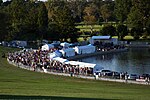
Wine Tasting consequence at Forest Park
-
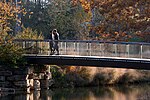
A footbridge in Forest Park
-

The Easter car show on the lower Muny parking lot
Brickline Greenway [edit]
The Brickline Greenway Project is a major public-individual partnership that aims to connect Forest Park and the Washington University in St. Louis Danforth Campus to the Gateway Arch grounds. Among the partners leading this projection are the Arch to Park Collaborative, St. Louis City, and Washington Academy in St. Louis.[74] [75]
The Brickline Greenway was known as the Chouteau Greenway prior to March 10, 2020. [76]
Meet also [edit]
- Culture of St. Louis
- Parks in St. Louis
- St. Louis MetroLink
- Wood Park-DeBaliviere MetroLink station
- Cardinal West End Metrolink Station
- Skinker Metrolink Station
- Bob Cassilly, sculpted statues in the zoo and the large turtle sculptures on the southern side of the park
- Delmar Loop Trolley
References [edit]
- ^ a b History of Forest Park
- ^ a b Vawter, Hayley (April 22, 2022). "St. Louis' Forest Park named all-time metropolis park in Us past USA Today". KSDK . Retrieved May three, 2022.
{{cite web}}: CS1 maint: url-status (link) - ^ New York Times (May 9, 2004).
- ^ a b c d e f Primm (1998), 306.
- ^ Loughlin, Caroline and Catherine Anderson; Forest Park, pages 5-10. The Inferior League of St. Louis, 1986.
- ^ Loughlin, Caroline and Catherine Anderson; Forest Park, page 11, 13. The Junior League of St. Louis, 1986.
- ^ St. Louis Upwardly To Date: The Great Industrial Hive of the Mississippi Valley. Richly Endowed by Nature every bit a Port of Entry, a Manufacturing Centre, and a Identify of Residence. A Glance at Her History, a Review of Her Commerce, and a Description of Her Leading Business Enterprises; With Illustrations of Her Public and Commercial Buildings and Places of Interest. St. Louis, MO: Consolidated Illustrating Visitor. 1895.
- ^ Loughlin, Caroline and Catherine Anderson; Woods Park, page iii. The Junior League of St. Louis, 1986.
- ^ Social club, Missouri Historical. "The Saint Louis Zoo: If Not Woods Park, Where? | Missouri Historical Society". The Missouri Historical Guild is ... Missouri Historical Society and was founded in 1866 . Retrieved November 8, 2020.
- ^ Primm (1998), 376.
- ^ a b c d Primm (1998), 393.
- ^ Spalding's report of the 1904 Summer Olympics. Archived August 29, 2011, at the Wayback Auto pp. 229, 231.
- ^ Matthews, George (2003). Images of America: St. Louis Olympics 1904. Chicago: Arcadia Publishing. ISBN0-7385-2329-1.
- ^ Lowenstein, M.J. (1904). Official Guide to the Louisiana Purchase Exposition. Louisiana Purchase Exposition Company. p. 212.
- ^ "X-Rays, 'fax machines' and ice cream cones debut at 1904 Earth'south Off-white". Washington University in St. Louis Newsroom.
- ^ Allen, Michael (Spring 2003). "The Harnessed Channel: How the River Des Peres Became a Sewer". Environmental of Absenteeism. Archived from the original on May nine, 2008. Retrieved May fourteen, 2008.
- ^ "Forest Park Principal Program". City of St. Louis. Retrieved May 14, 2008.
- ^ a b c "St. Louis City Ordinance 67477". Archived from the original on September one, 2007. Retrieved July 27, 2011.
- ^ a b c d e St. Louis Business concern Journal (March 19, 2006).
- ^ a b c St. Louis Postal service-Dispatch (January 23, 2007)
- ^ a b St. Louis Business Journal (Feb 22, 2007).
- ^ a b c d eastward Metropolis of St. Louis Parks Department: Parking and Admission Report Archived June 23, 2011, at the Wayback Motorcar.
- ^ The St. Louis Cardinals had 3.3 million visitors in 2010, according to St. Louis Business organisation Journal (October 17, 2010), while the Jefferson National Expansion Memorial had 2.iv 1000000 visitors in 2010, according to National Park Service Statistics.
- ^ "Best Metropolis Park (2022)". USA Today . Retrieved April 26, 2022.
{{cite web}}: CS1 maint: url-status (link) - ^ Fox2Now (April iii, 2011) Archived October 6, 2011, at the Wayback Machine.
- ^ Riverfront Times (March 29, 2011) Archived April 1, 2011, at the Wayback Auto.
- ^ http://stlafricanartsfest.org/ [ dead link ]
- ^ a b c d e "Woods Park Forever: Result Agenda 2011" (PDF). Archived from the original (PDF) on August 13, 2011. Retrieved July 27, 2011.
- ^ "Forest Park Cantankerous Country Festival | September 12–13, 2020". Wood Park Cross Country Festival . Retrieved November 8, 2020.
- ^ University News (July 1, 2011).
- ^ "Woods Park presents new opportunities for Fair St. Louis". St. Louis Post-Acceleration. June 26, 2014.
- ^ "Off-white St. Louis in Forest Park gets off to a polish offset". St. Louis Postal service-Dispatch. July 3, 2014.
- ^ City of St. Louis Parks Department: Wood Park. Archived June 23, 2011, at the Wayback Machine
- ^ St. Louis Zoo: History Archived July 26, 2011, at the Wayback Machine.
- ^ a b c St. Louis Post Dispatch: Zoo Museum District by the numbers.
- ^ a b St. Louis Zoo: Animals
- ^ a b St. Louis Zoo: Your Visit Archived July 28, 2011, at the Wayback Machine.
- ^ Forest Park Forever: Science Center.
- ^ St. Louis Scientific discipline Middle: Planetarium Archived July 24, 2011, at the Wayback Motorcar.
- ^ "St. Louis Science Heart: Public Stargazing". Archived from the original on August 5, 2011. Retrieved July 26, 2011.
- ^ Missouri History Museum: Seeking St. Louis
- ^ Missouri History Museum: 1904 Globe's Off-white, Looking Dorsum at Looking Forward
- ^ a b c d east f g h i j g 50 m n o p q r s t St. Louis City Parks Department: Statues and Fountains Archived June 23, 2011, at the Wayback Machine
- ^ a b Forest Park Forever: Missouri History Museum
- ^ a b St. Louis Art Museum: History
- ^ Saint Louis Art Museum: Collections
- ^ a b "St. Louis Fine art Museum: Expansion". Archived from the original on July 20, 2011. Retrieved July 26, 2011.
- ^ a b c The Muny: History
- ^ a b c City of St. Louis Parks Department: Precious stone Box Archived June 23, 2011, at the Wayback Auto
- ^ "National Annals of Historic Places - Nomination Class - Jewel Box" (PDF). Missouri Department of Natural Resources. Retrieved May thirty, 2008.
- ^ a b Sandweiss, Lee Ann (2001). Missouri History Museum (ed.). St. Louis Compages for Kids. Juvenile Nonfiction.
- ^ a b "All-time Picnic Spot 2011: Turtle Park". Riverfront Times. St. Louis. 2011. Retrieved November vi, 2015.
- ^ a b c Urban center of St. Louis Parks Department: Dwight Davis Tennis Middle Archived June 23, 2011, at the Wayback Car
- ^ a b City of St. Louis Parks Department: Boathouse Archived June 23, 2011, at the Wayback Machine
- ^ a b Boathouse Restaurant: History
- ^ a b c d e f g h i j thousand City of St. Louis Parks Section: Master Programme Archived June 23, 2011, at the Wayback Machine
- ^ a b c d eastward f thousand Metropolis of St. Louis Parks Department: Visitor Center Archived June 23, 2011, at the Wayback Machine
- ^ Urban center of St. Louis Parks Department: Bicycle Rentals Archived June 23, 2011, at the Wayback Auto.
- ^ a b c d City of St. Louis Parks Department: Steinberg Skating Rink Archived June 23, 2011, at the Wayback Car
- ^ Steinberg Skating Rink
- ^ a b c d "Forest Park Golf Course: History". Archived from the original on September x, 2011. Retrieved July 27, 2011.
- ^ a b c "Wood Park Forever: Golf". Archived from the original on July 2, 2011. Retrieved July 27, 2011.
- ^ Riverfront Times: All-time Golf Course 2008.
- ^ a b c d "Highlands Golf and Tennis: History". Archived from the original on March 28, 2012. Retrieved July 27, 2011.
- ^ "Missouri Department of Conservation: Woods Park Fish Hatchery". Archived from the original on July 17, 2011. Retrieved July 27, 2011.
- ^ a b "Wood Park Forever: Kennedy Woods and Kennedy Woods". Archived from the original on July 23, 2011. Retrieved July 27, 2011.
- ^ a b c d east City of St. Louis Parks Department: Cabanne House Archived June 23, 2011, at the Wayback Machine.
- ^ a b "National Register of Historic Places Registration Course" (PDF). National Annals of Historic Places. National Park Service. Dec 23, 1985. p. 2.
- ^ St. Louis Ambassadors: History Archived December 26, 2010, at the Wayback Machine.
- ^ "Cohnipedia: The story of Forest Park's Jewish monument". St. Louis Jewish Light. July thirteen, 2011. Archived from the original on August half-dozen, 2017. Retrieved July 13, 2011.
- ^ "Confederate Memorial". Retrieved June 11, 2017.
- ^ "Amalgamated Memorial". Archived from the original on June 29, 2017. Retrieved June 11, 2017.
{{cite web}}: CS1 maint: bot: original URL status unknown (link) - ^ Bott, Celeste (June 28, 2017). "Remaining pieces of Confederate Monument removed from Forest Park". St. Louis Post-Acceleration . Retrieved August 13, 2017.
- ^ "WashU a partner in greenway project to connect Forest Park to the Arch". Washington University School of Medicine in St. Louis. October 11, 2017. Retrieved Baronial 3, 2019.
- ^ "Chouteau Greenway Primary Plan". Not bad Rivers Greenway . Retrieved August 3, 2019.
- ^ "Brickline Greenway". Keen Rivers Greenway . Retrieved May 23, 2020.
- "The Mississippi River in Forest Park". City of St. Louis. Retrieved May fourteen, 2008.
External links [edit]
- St. Louis Convention & Visitors Commission Fact Sheet on Forest Park
- Forest Park Map (pdf)
- "Forest Park photographs". University of Missouri–St. Louis.
- Website for Wood Park (urban park located roughly on the site of the off-white)
Source: https://en.wikipedia.org/wiki/Forest_Park_(St._Louis)
0 Response to "What Time Dioes the Art Musem Open in Forest Park"
Post a Comment